Engagement
What Happens in an Engagement Ceremony? A Complete Guide for First-Time Couples
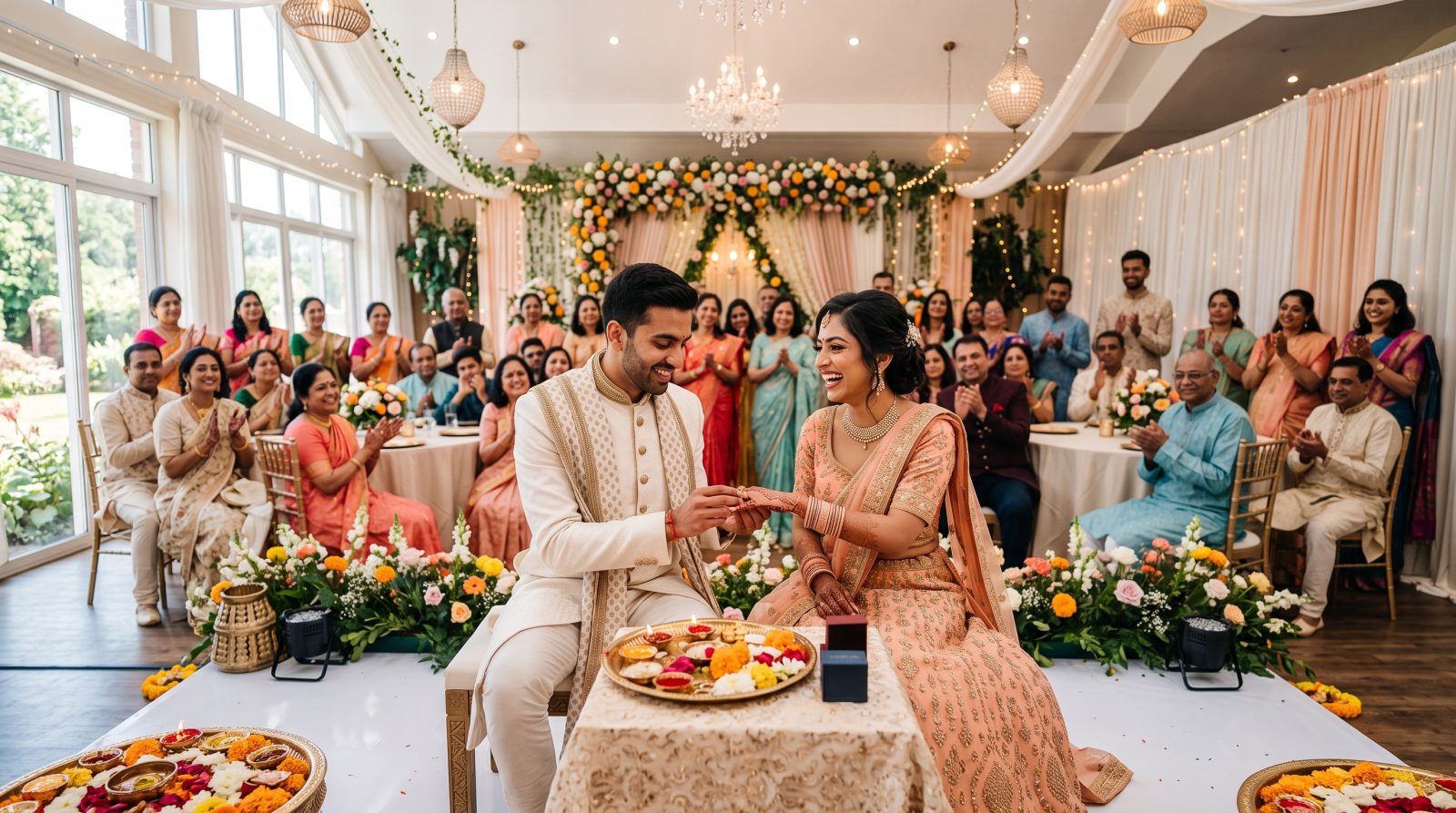
An engagement ceremony is the event where two families formally confirm a marriage agreement in front of witnesses. The couple exchanges rings, elders bless them, both sides exchange gifts and sweets, and the wedding date is announced or fixed. Most Indian engagement ceremonies run three to five hours.
That is the short version.
The longer version is the one nobody hands to first-time couples the order things actually happen in, how long each part really takes, and the two or three small decisions that quietly decide whether dinner is served at eight or at ten.
Here it is, start to finish.
Why this day carries more weight than the ring photo
For most couples, the engagement is the first time both families sit in the same room with nothing else on the agenda. The wedding is too busy for that. The engagement is not.
Which is why the rituals are built around introductions and blessings rather than spectacle. Elders are named out loud. Gifts move in both directions in equal measure. Somebody's grandmother will tell a story about a wedding from 1974.
None of that shows up in the photographs, and all of it is the reason the ceremony exists.
One ceremony, many names
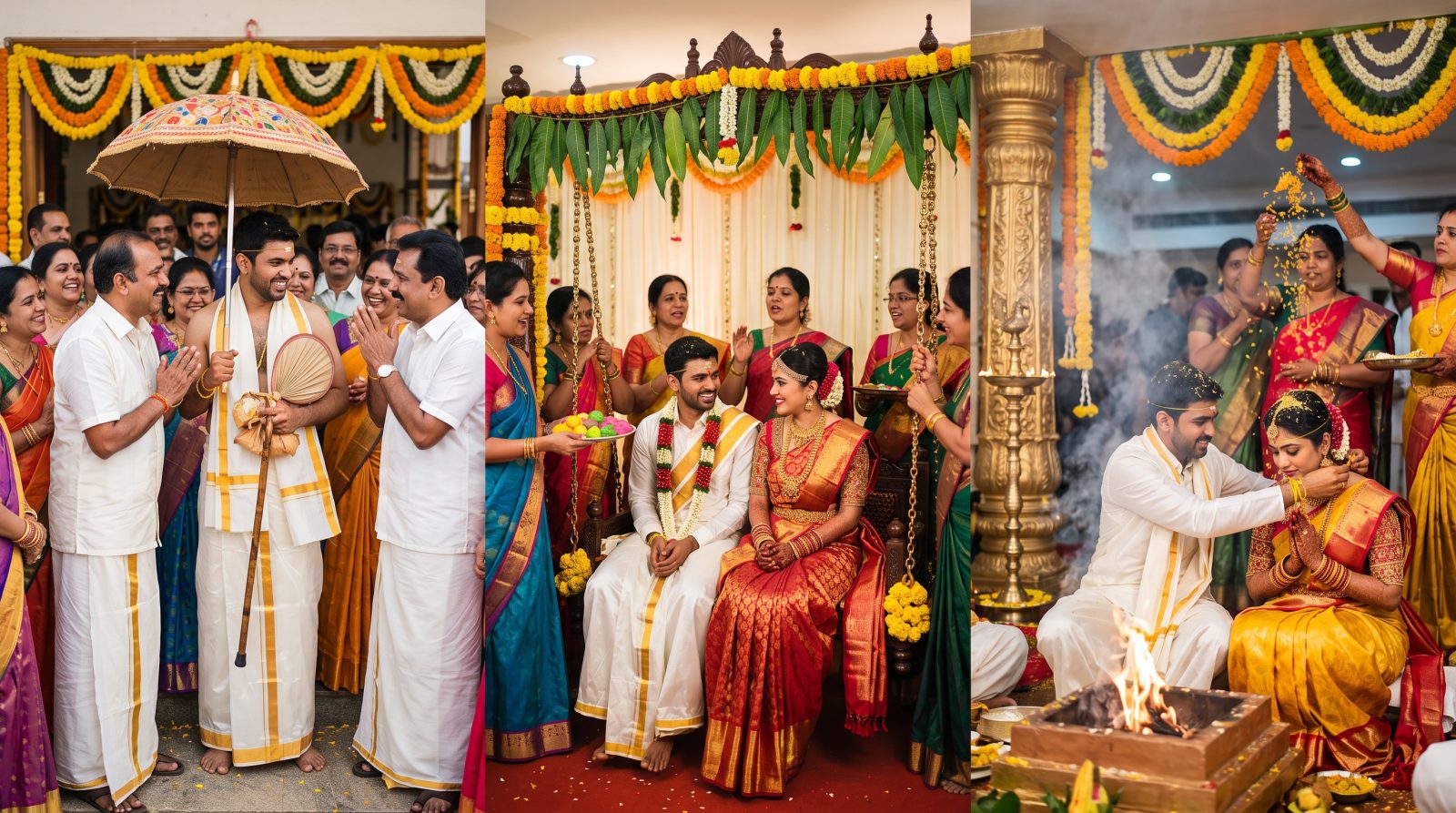
What you call it depends on where your family is from, but the sequence barely changes.In Bangalore, where the two families often come from two different states, blending is normally a Kannada priest-led ritual in the first half, a North Indian sagai format for the ring exchange in the second.
Settle that blend with both sets of elders before the invitations are printed. It is a five-minute conversation in January and a very different conversation in the morning itself.
What happens at an engagement ceremony, step by step?
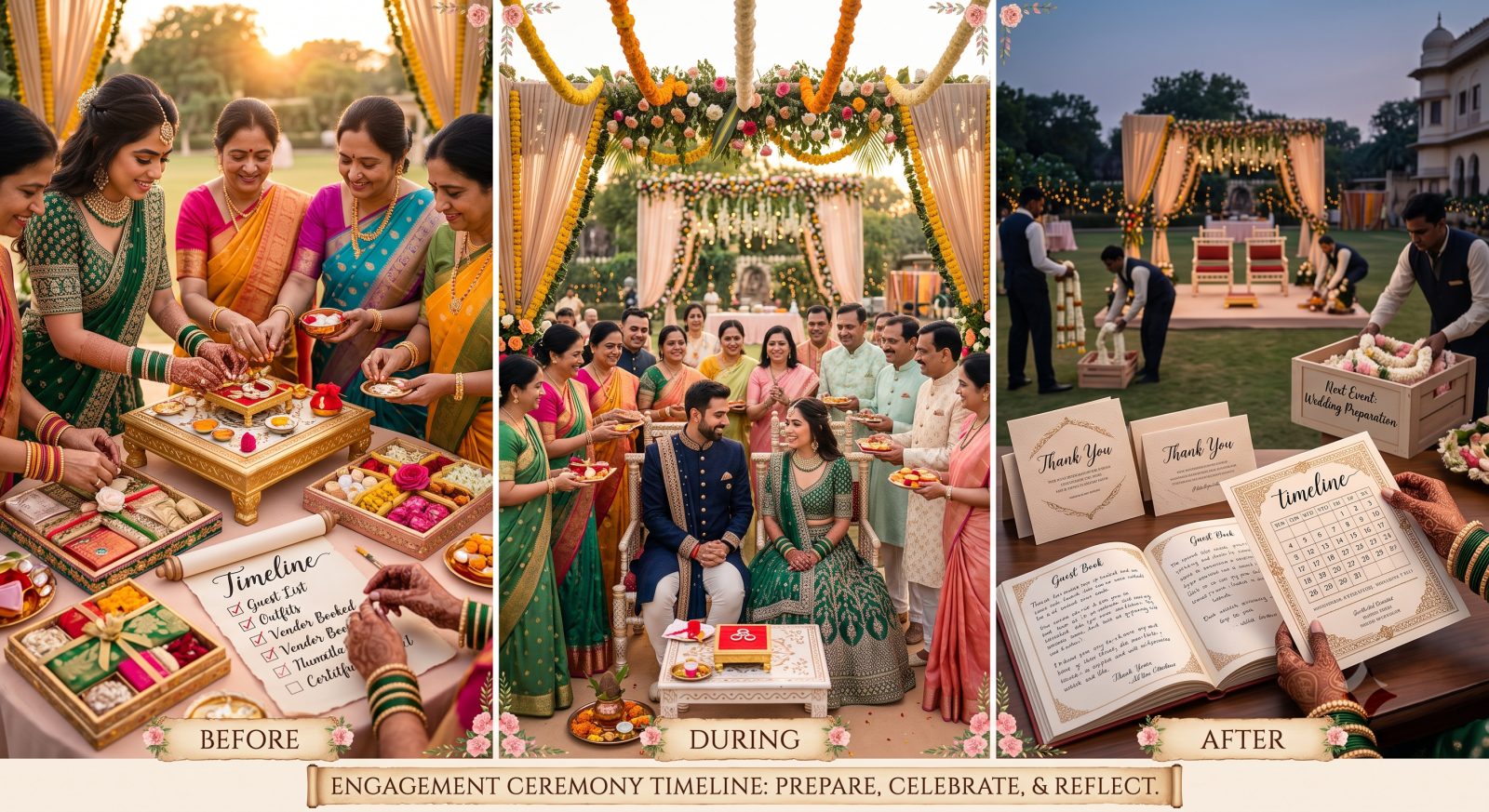
A traditional Indian engagement moves through eight stages. It helps to think of them as three parts of an evening rather than a checklist.
Part one: the arrival
1. The groom's family arrives and is welcomed. The bride's family receives them at the entrance with an aarti, a tilak and welcome drinks. Budget 20 to 30 minutes, because guests arrive in batches, never together.
2. A prayer or puja opens the ceremony. Most Hindu families begin with a Ganesha puja led by a priest, running 20 to 40 minutes. Christian and Muslim families substitute a prayer or a short reading. This is the calmest part of the day.
Part two: the ceremony itself
3. Both families are formally introduced. Elders from each side introduce their family members by name and relation. This step is the actual point of the ceremony: the marriage is being agreed between families, not just between two people.
4. The rings are exchanged. The bride places a ring on the groom's finger, then the groom on hers, usually while an elder or the priest says a few words. Every camera in the room is waiting for this, and it is over in under five minutes.
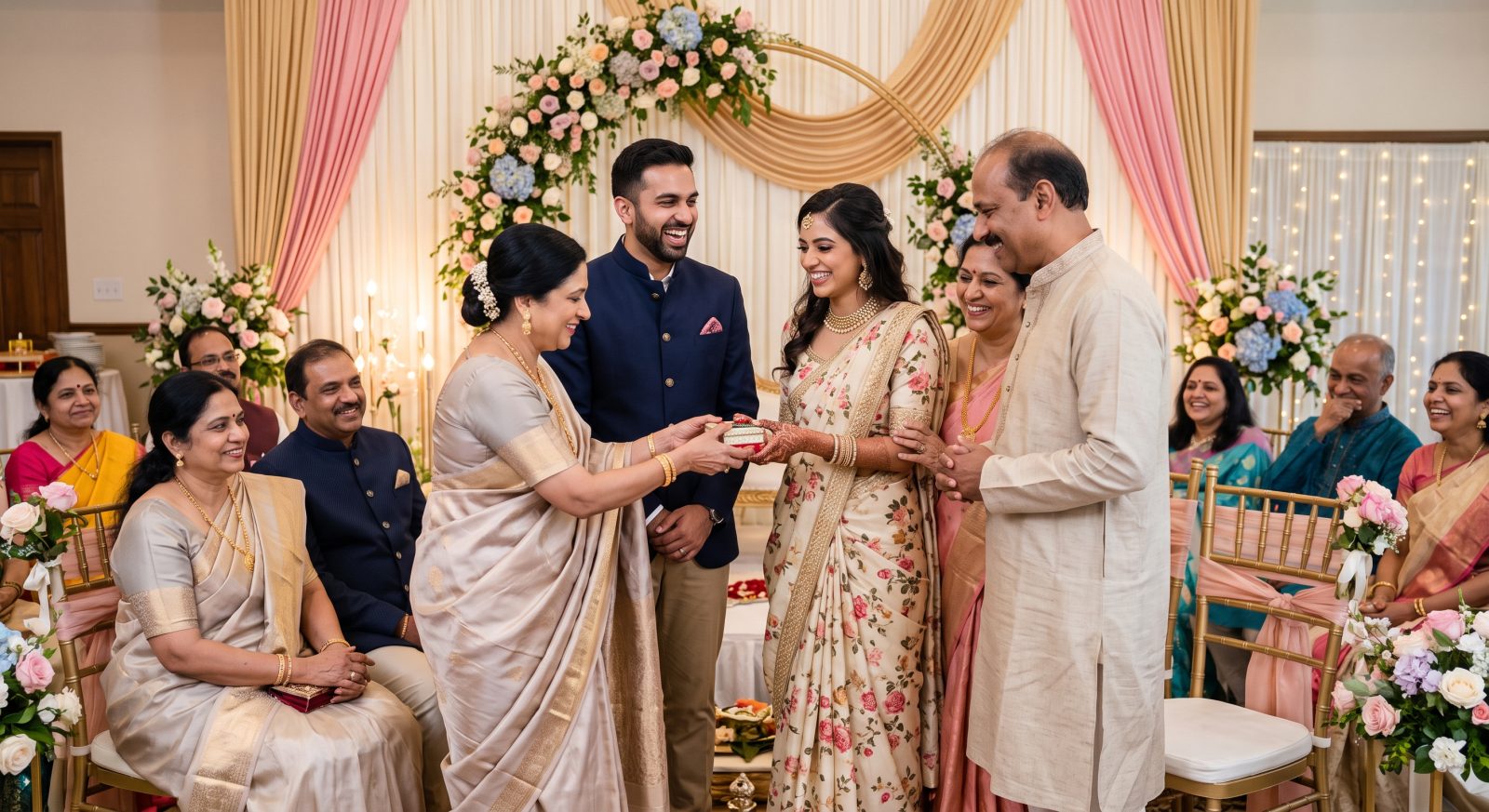
5. The elders bless the couple. Grandparents, parents, aunts and uncles come forward one by one with turmeric-coated rice, flowers, or a shawl placed on the shoulders. With a large family this takes longer than the ring exchange several times over.
Part three: the announcement and the celebration
6. Gifts, thamboolam and sweets are exchanged. Trays of clothes, dry fruits, betel leaves, coconut and sweets pass between the families. Both sides usually prepare a matching number of trays as a courtesy, more on that below.
7. The wedding date is announced. The priest reads out the chosen muhurat, or an elder announces the date. Some families also read a written agreement aloud the lagna patrika, naming both families and the wedding date.
8. Photographs, then dinner. Family group photos first, the couple's portraits second, dinner last. This is the longest block of the evening, and reliably the one where the schedule slips.
How long does an engagement ceremony take?
Overall: Plan for approximately four to five hours from guest arrival through dinner.
Morning ceremonies follow the same order, shifted earlier, ending with lunch instead of dinner.
One planning note that saves a lot of stress: if your family has fixed an auspicious muhurat for the ring exchange, build the schedule backwards from that minute rather than forwards from the arrival time. Everything before it is flexible. That one moment is not.
From the living room to the banquet hall
Traditionally the bride's family hosts, at home. For a ceremony of 30 to 50 guests, that still works beautifully.
Past about 75 people, it stops working and it stops working in a specific order. First there is nowhere to seat elders comfortably. Then there is no surface for the gift trays. Then someone blocks a neighbour's car, and that becomes the thing people remember.
Most Bangalore families now book a hall for the day, and the reason is the ritual sequence itself: you need a stage for the ring exchange, a separate space for the puja, room for a queue of elders to move through, and a dining area that can be laid out while the ceremony is still running.
If you are weighing up engagement venues in Bangalore, compare them on those four zones rather than on seating capacity alone. A 300-seat hall with one open floor handles an engagement worse than a 150-seat hall with a proper stage and an adjoining dining space.
There is a second question worth asking early: are you holding the engagement and the reception on the same day? Plenty of couples now do, particularly when one side is travelling in from another city. If that is the plan, ask the venue directly how long the changeover between the two takes and who handles it. Same-day schedules almost always break at exactly that seam.
Five things first-time couples get wrong
These come up again and again, and every one of them is avoidable.
Underestimating the blessings. Families count 40 guests and forget that 30 of them will individually bless the couple. Build in 30 minutes, not 10.
Not briefing the photographer on the ring moment. It lasts seconds and cannot be re-staged convincingly. Agree the exact camera position the day before.
Leaving the elders' seating to chance. Chairs near the stage, out of the walkway, with a clear view, decide this before the decorator sets up, not after.
Mismatched gift trays. If one side brings eleven trays and the other brings five, somebody notices, and it is remembered. One phone call between the families settles it.
Nobody owns the clock. Assign a cousin or a close friend as timekeeper. Without one, the puja overruns, photographs eat an hour, and dinner starts at ten.
What should the couple wear?
Engagement outfits are traditional but deliberately lighter than wedding wear. Brides usually choose a silk saree or a lehenga in a lighter weight than the wedding one; grooms wear a kurta, a sherwani, or a well-cut formal suit.
The practical test is simple. Can you sit cross-legged through a puja and then stand for 45 minutes of photographs in the same outfit? If the answer is no, change one element, usually the jewellery or the dupatta, rarely the whole look.
Small touches that make the day feel like yours
The rituals are fixed. Everything around them is not, and this is where couples make the day their own without upsetting anyone's tradition.
A memory table near the entrance with both sets of parents' and grandparents' wedding photographs. It quietly makes the point the ceremony is already making.
Menus drawn from both families' regions rather than one — a small gesture that guests notice immediately.
A short handwritten note read out by each family, instead of only the priest speaking. Two minutes each, no more.
Giving the grandparents a formal role in the ring segment, not just a seat in the front row.
A shared playlist for the dinner hour, built from songs both families actually know.
None of these cost much. All of them are the parts people bring up years later.