Wedding
Wedding Rituals Explained: Meaning Behind Every Ceremony

Indian wedding rituals are a sequence of ceremonies that move a couple out of two separate families and into one household. Each one has a job: blessing, purification, consent, the binding moment itself, and the welcome that follows. In South India most of them are packed into a two to three hour muhurtham window, which is why the whole thing can feel rushed if you do not know what you are watching.
Why does a Hindu wedding have so many rituals?
Because the wedding is not treated as one event. Sanskrit tradition lists sixteen samskaras, the sacraments that mark a life, and vivaha is the only one designed to be performed in front of witnesses. Fire, water, turmeric and rice are all treated as witnesses in their own right. The priest formally invites Agni, the fire, to observe the vows. Nothing is considered settled until the fire has seen it, and that single idea explains most of the sequence.
The order is fixed, but the calendar is not. Priests fix muhurtham dates from the Panchangam, which is why bookings cluster into a few weeks of Vaishakha, the Kartika and Margashira months, and the stretch from late January through May. Ashada and the sixteen days of Mahalaya Paksha are skipped almost entirely. Families who understand this book their venue eleven months out for a February date and negotiate comfortably for a July one.
What happens in the pre-wedding rituals?
Nischayathartham, the engagement, is where the lagna patrika is read aloud. It is a written declaration of the date and the exact muhurtham minute fixed by the family priest. Once both fathers sign it, the date is locked and invitations go out.
Pellikuthuru and pellikoduku in Telugu homes, nalangu in Tamil ones, happen the day before. The bride and groom are bathed at their own homes in turmeric, oil and sandalwood paste. Turmeric is antiseptic and it is also the colour of auspiciousness. Both reasons get quoted, and both are true.
Mehendi came into South Indian weddings later, through the north, and stayed because it works. Henna cools the skin and gives a nervous bride two quiet hours with her cousins before a very long day. The old line about a darker stain meaning a stronger marriage is folklore, not scripture.t
Sumangali prarthanai, performed in Tamil Brahmin families, is a meal offered to married women in the family line, living and remembered. It asks for a long married life for the bride.
What do the wedding-day ceremonies mean?
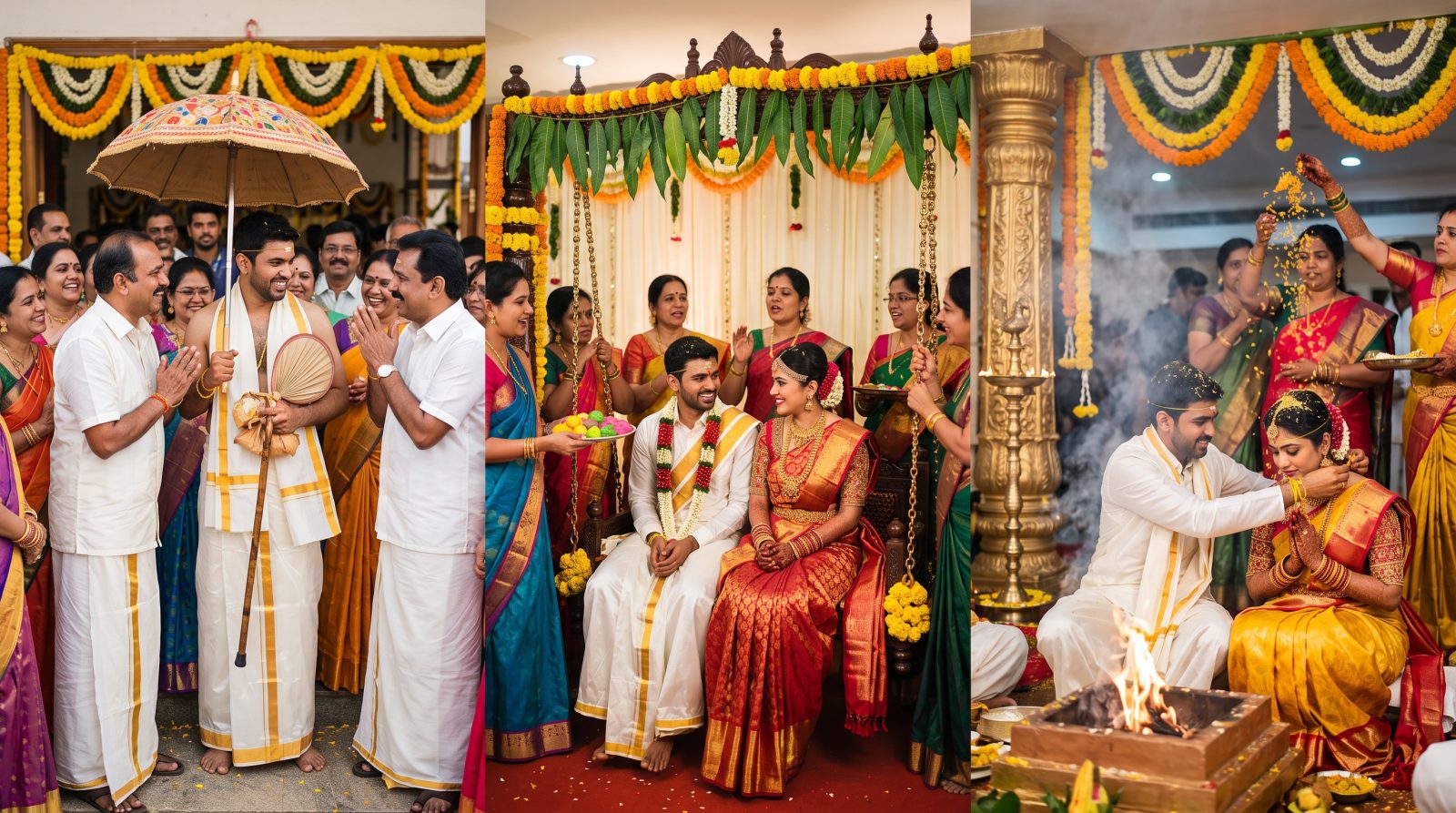
Kashi Yatra opens the muhurtham. The groom announces that he is giving up on marriage and leaving for Kashi to become a monk, then walks off carrying an umbrella, a hand fan and a walking stick. The bride’s father stops him at the gate and offers his daughter. Everybody laughs, everybody knows the script, and the point still lands: the groom is publicly choosing family life over renunciation.
The garland exchange is the first act of mutual consent, done standing, in front of every guest. Cousins lifting the groom so the bride cannot reach his neck is not a ritual. It is just cousins.
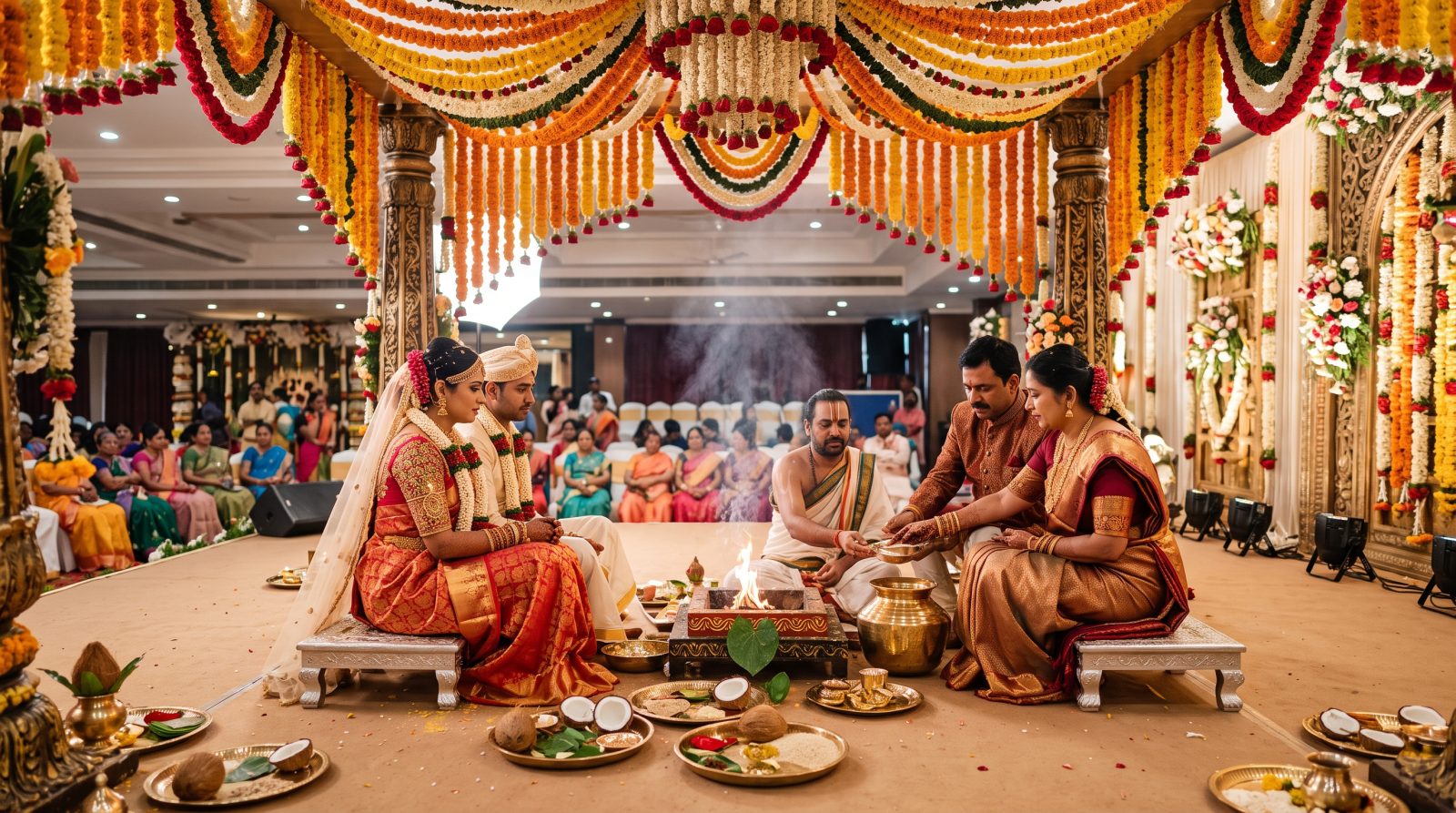
Kanyadaanam is the father placing his daughter’s hand into the groom’s and pouring water over their joined hands. Water is used because poured water cannot be gathered back.
Jeelakarra bellam, specific to Telugu weddings, is a paste of cumin and jaggery that the couple presses onto each other’s heads at the exact muhurtham minute. Bitter and sweet together, held at the crown, for a life that will contain both.
Then the thali, or mangalsutra. The groom ties the first knot and his sister ties the second and third. The nadaswaram and thavil go loud at this moment, a burst called getti melam, partly celebration and partly to make sure no inauspicious word is heard over the knots.
Saptapadi is the seven steps taken around the fire, one vow to a step: food, strength, wealth, happiness, children, health, friendship. It also carries legal weight. Under Section 7 of the Hindu Marriage Act, 1955, where saptapadi is part of the custom, the marriage is complete and binding on the seventh step.
Talambralu follows, and it is the only ritual nobody performs seriously. The couple pours handfuls of rice mixed with turmeric and pearls over each other’s heads until both are buried in it. Then the priest points to Arundhati, the faint star beside the second star of the Big Dipper, and the couple looks up at a marriage that has held for a very long time.
How do you plan the day around the rituals?
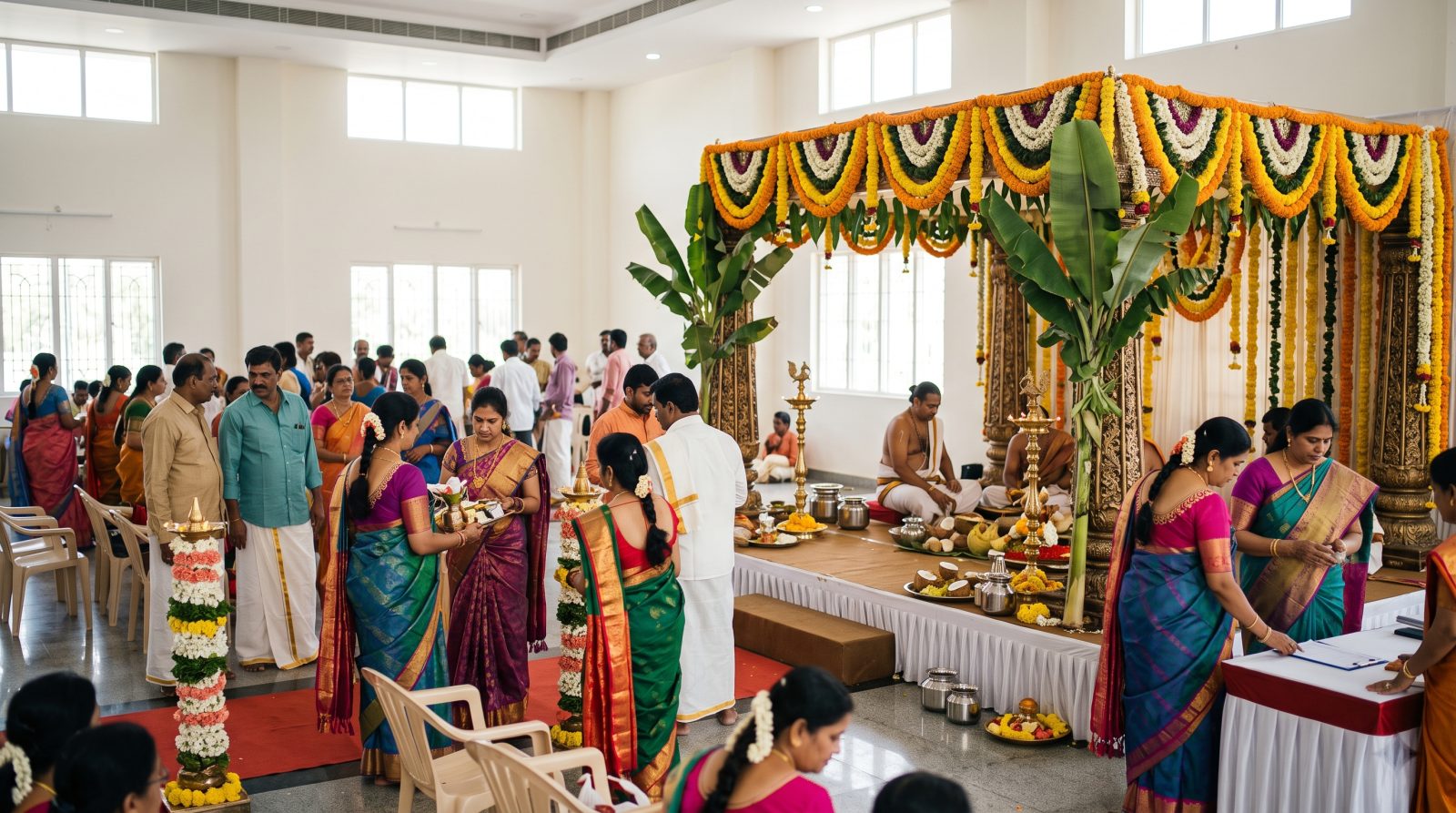
The rituals set the timing, not the venue. A 5:40 am muhurtham means the hall opens at 3 am for decoration and the kitchen starts the sadhya by 4. That one number decides your staffing, your generator hours and whether your guests get coffee.
Most wedding places in bangalore price the muhurtham slot and the reception slot separately, so the question to ask before signing is whether haldi and mehendi can run on the same property the previous day. For families flying guests in from Chennai, Hyderabad or the Gulf, holding all three days in one venue usually costs less than two cheaper halls plus the travel between them.
How do rituals differ across South India?
Tamil weddings put their weight on the thali and the sumangali prarthanai. Telugu weddings build to kanyadaanam, jeelakarra bellam and talambralu. Kannada weddings centre on dhare eraeyodu, the pouring of water over the joined hands with a coconut held above. Malayali Hindu weddings are the shortest in the country, often finished inside twenty minutes: the thali is tied, a pudava is given, the couple circles the lamp three times and it is done.
Christian weddings in Bangalore follow the church order, with vows, rings and the signing of the register, and the reception carries the celebration. Nikah ceremonies are built around the mehr agreed in advance and the qubool said three times in front of witnesses, followed by the walima hosted by the groom’s family.
What happens after the wedding?
Griha pravesham is the bride’s first entry into her new home. She tips over a measure of rice with her right foot at the doorway so that abundance enters ahead of her. Nalangu games follow, and they are deliberately silly, because the two families have just met and somebody has to break the ice.
The reception is the only part of the whole schedule with no scriptural rule attached to it. That is exactly why families spend their design budget there. Nobody can shorten saptapadi, but anybody can change the stage, the menu and the music.
Ask your priest for a written timeline with each ritual and its duration, then hand that same sheet to the venue manager, the caterer and the photographer. Most wedding-day chaos in Bangalore is not a ritual problem. It is three vendors working from three different schedules.
Frequently Asked Questions
Which ritual makes a Hindu marriage official?
Saptapadi. The seventh step around the fire completes the marriage, and Section 7 of the Hindu Marriage Act, 1955 recognises it where the custom includes it.
How long does a South Indian wedding ceremony take?
The muhurtham ceremony runs two to three hours. The full wedding, counting pre-wedding rituals and the reception, usually takes two to three days.
Why is turmeric used in wedding rituals?
Turmeric is antiseptic and it was the skin preparation before modern products existed. It is also the colour of auspiciousness, which is why it appears in the bath, the thali thread and the talambralu rice.
What is jeelakarra bellam?
A paste of cumin and jaggery that a Telugu couple presses onto each other’s heads at the exact muhurtham minute. Bitter and sweet held together stands for a shared life that will contain both.
Can wedding rituals be shortened?
Yes. Priests regularly condense the muhurtham to forty-five or sixty minutes by trimming the recitations while keeping kanyadaanam, the thali and saptapadi intact. Agree on the cuts with the priest a week ahead, not on the morning.