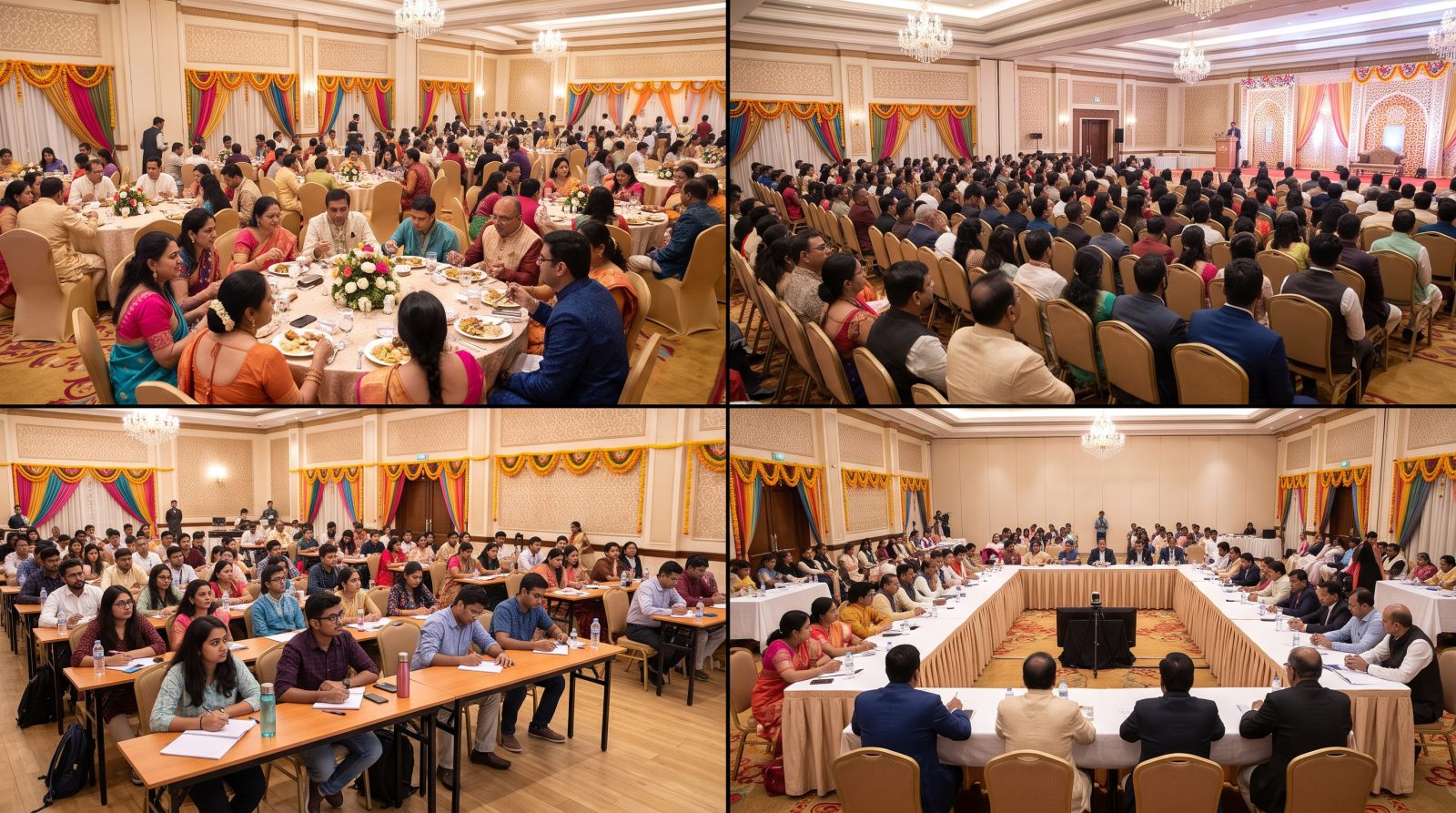
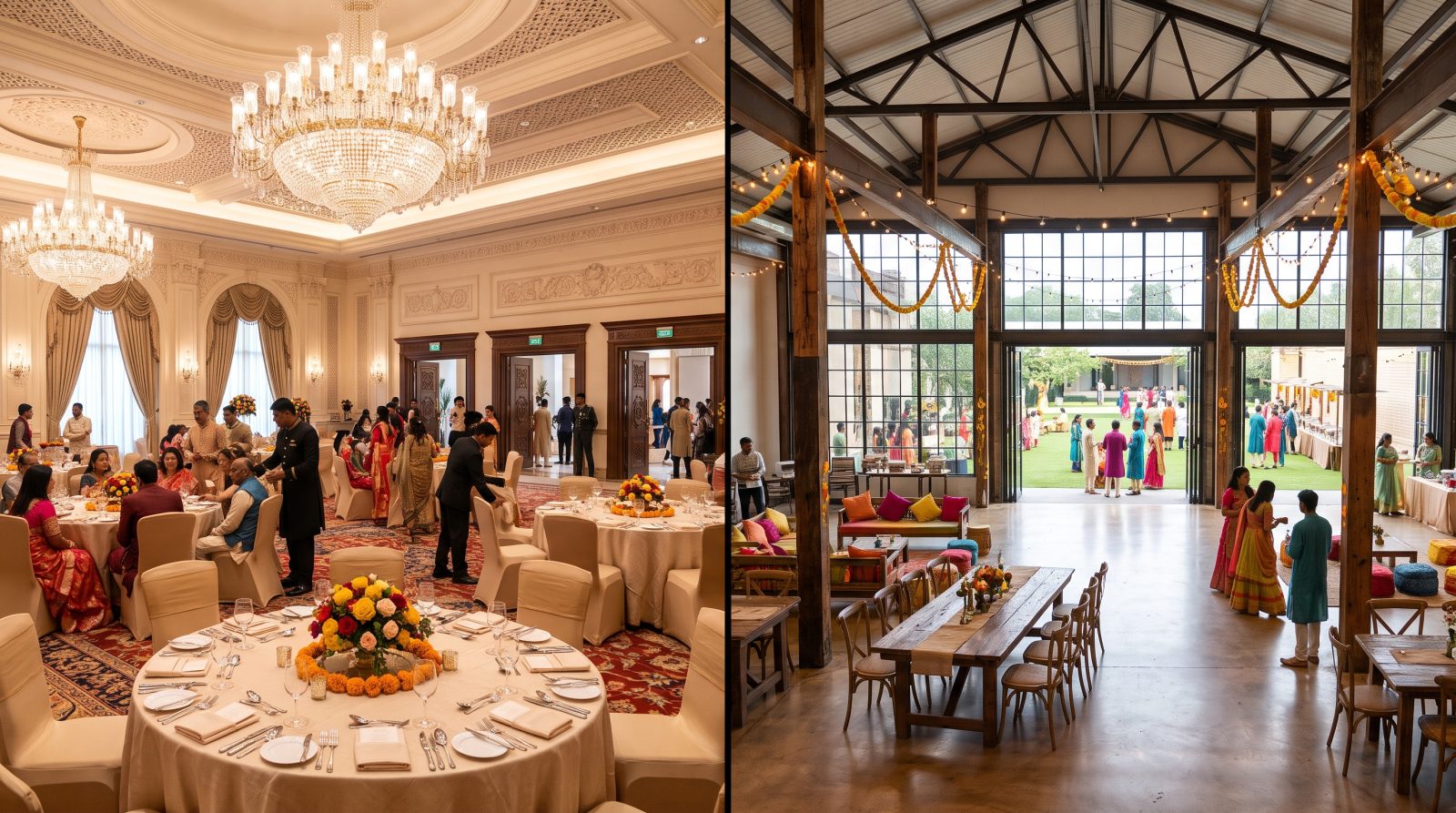
Banquet Hall
How to Compare Banquet Halls Based on Price, Capacity and Amenities
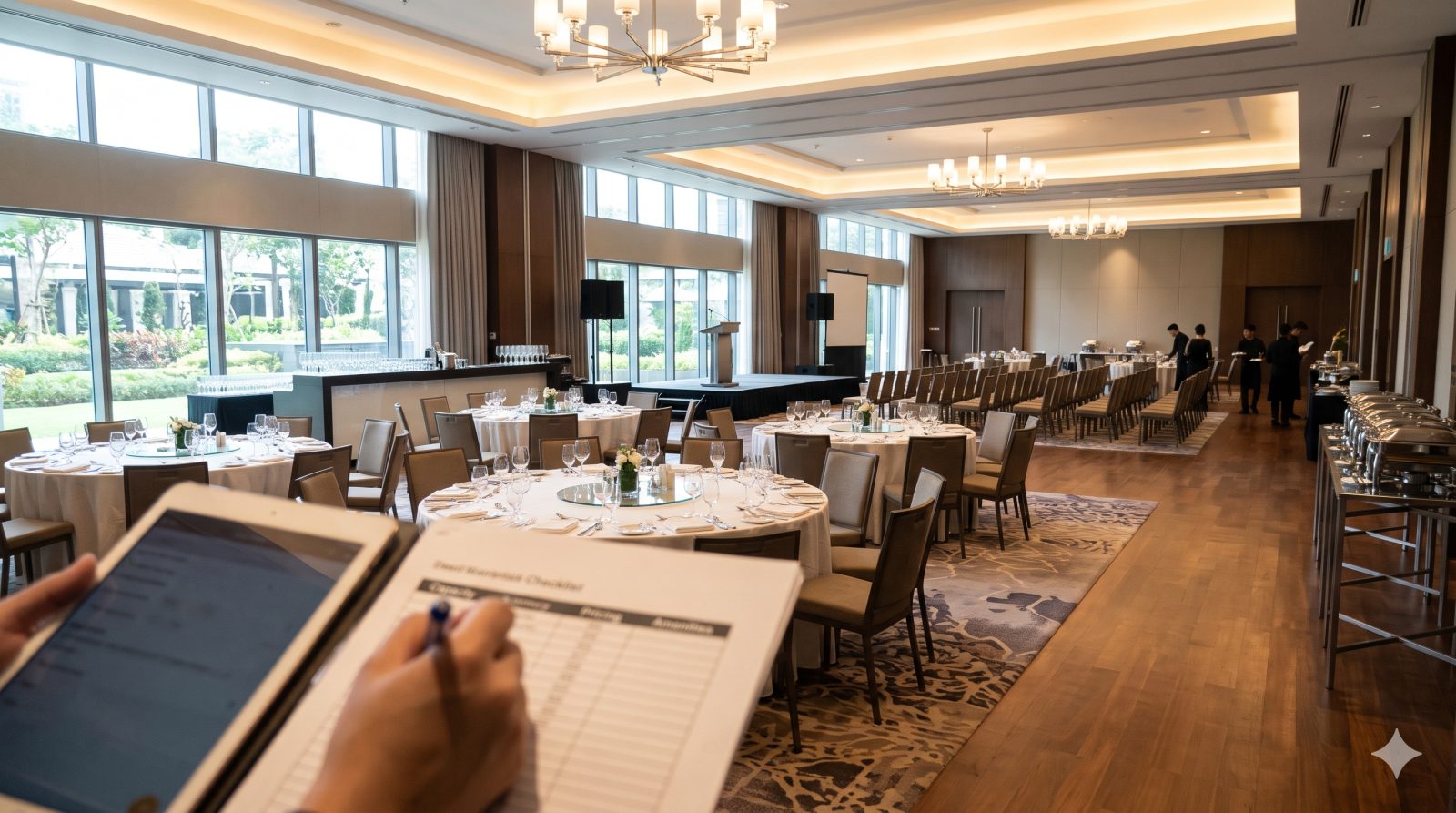
To compare banquet halls fairly, turn every quote into one all-in cost per guest, check the seated capacity for your exact layout instead of the maximum number the venue advertises, and score each hall only on the amenities your event really needs. The hall with the lowest headline price is often not the cheapest once rent, taxes and extra charges are added.
Most families and event planners end up with three or four shortlisted halls and no clear way to choose. One quotes a per plate rate, another a flat rent, a third a package with decor thrown in. It really comes down to three questions: what will this hall cost me, will my guests fit comfortably, and does it have what my event needs? This guide walks through each one.
Why Is Comparing Banquet Halls So Confusing?
Banquet halls price their services in different ways, so headline numbers rarely line up. Some charge only for food and give the hall free above a minimum number of plates. Others charge hall rent plus catering. Many offer packages that mix food, decor and lighting into a single figure.
The price spread is also wide. Venue listings on WedMeGood for Bangalore show veg menus from about ₹750 to ₹3,000 per plate and non-veg menus from about ₹1,250 to ₹3,500, depending on the type of venue. VenueLook puts typical hall rental in Bangalore at roughly ₹40,000 to ₹1,80,000. With ranges this broad, comparing one hall's ₹900 plate with another's ₹1,200 plate tells you very little on its own.
Step 1: How Do You Compare Banquet Hall Prices Fairly?
The fairest way to compare prices is to convert every quote into an all-in cost per guest. That means adding up food, rent, decor, taxes and every extra charge, then dividing by the number of guests you actually expect.
Ask every venue for the same price breakdown
Send each hall the same list of questions so the answers are easy to put side by side:
- Per plate rate for veg and non-veg menus, and what each menu includes
- Minimum guarantee, which is the number of plates you pay for even if fewer guests come
- Hall rent, if any, and how many hours it covers
- Decor, lighting and sound charges, and whether outside decorators are allowed
- GST on each part of the bill, and whether the quote includes it
- Generator or power backup charges, extra hour charges and valet fees
- Security deposit amount, and the rules for getting it back
Work out the all-in cost per guest
Here is a simple example with round numbers. Hall A charges ₹1,000 per plate with a minimum guarantee of 300 plates and no rent. Hall B charges ₹850 per plate plus ₹75,000 hall rent, with no minimum.
If you expect 250 guests, Hall A still bills you for 300 plates, which is ₹3,00,000, or ₹1,200 per guest. Hall B costs ₹2,12,500 for food plus ₹75,000 rent, which is ₹2,87,500, or ₹1,150 per guest. Hall B wins even though it charges rent.
Now change the guest count to 350. Hall A costs ₹3,50,000, or ₹1,000 per guest. Hall B costs ₹2,97,500 plus ₹75,000, which is ₹3,72,500, or about ₹1,064 per guest. This time Hall A is cheaper. The lesson is simple: the right hall on price depends on your real guest count, so do this sum for every venue before you decide.
Watch the dates and the fine print
The same hall can cost very different amounts on different days. VenueLook notes that prices rise in the peak wedding months of November to February and on popular auspicious dates. If your date is flexible, ask each hall for a weekday or off-season rate. Also read the cancellation policy closely, because the advance is often the largest amount you pay before the event.
Step 2: How Do You Check Whether a Hall Fits Your Guest Count?
Always ask for the hall's capacity in the exact layout you plan to use. The large number on a venue's website is often its floating capacity, meaning guests standing and moving around, which can be far higher than the number who can sit and eat in comfort.
Seated and floating capacity are not the same
A common planning rule is to allow 10 to 12 square feet per guest for a seated dinner, as event planning guides such as Giggster suggest. A standing crowd needs much less room, often 6 to 10 square feet each depending on the guide you follow. So a 5,000 square foot hall might hold around 400 to 500 seated guests in theory, before you set aside space for the stage, the buffet counters and a dance floor. Ask the venue for a floor plan showing your layout, not just a headline figure.
Look at how guests will move, not just where they sit
Capacity is also about flow. Check how many buffet counters the hall can set up, whether the dining area is separate and how many guests can eat at once. Many South Indian weddings serve meals in batches, so a smaller dining hall can work if service is quick.
Parking deserves its own question. If you are shortlisting a banquet hall in Bangalore, ask how many cars the venue can park, whether valet is included and how traffic looks on that road at the time your event starts. A hall with a perfect stage and no space for cars will leave guests stuck outside on the big day.
Do not book a hall that is too big
A hall built for 1,000 guests can feel empty with 250, and the photos will show it. You also pay more for decor to fill the space. Aim for a hall where your guest count sits comfortably within its seated capacity, with a small buffer for last minute additions.
Step 3: Which Banquet Hall Amenities Matter Most?
The amenities that matter most are the ones that protect your event if something goes wrong: power backup, air conditioning that can handle a full hall, parking, clean washrooms and a reliable catering team. Everything else is a bonus.
Must-have amenities
- Power backup that runs the air conditioning and lights, not just a few fans
- Air conditioning sized for the hall when it is full of guests
- Parking or valet service for your expected number of cars
- In-house or approved catering, with a food tasting before you book
- Clean washrooms in enough numbers for your guest count
- Bride and groom rooms, or green rooms, for changing and getting ready
- Clearly marked fire exits and a lift or ramp for elderly guests
Nice-to-have amenities
- An in-house decor team that already knows the space
- LED screens, stage lighting and a sound system included in the price
- Guest rooms on site or close by for out of town family
- A dedicated event coordinator on the day
Score each hall with a simple checklist
Give every must-have amenity two points and every nice-to-have one point. Add up the score for each hall and write it next to its all-in cost per guest. This stops one impressive feature, like a grand entrance or a chandelier, from distracting you from a missing basic like weak power backup.
How Do You Make the Final Decision?
Bring it down to three numbers for each venue: the all-in cost per guest, the seated capacity for your layout and the amenity score. The best hall is usually the one with a fair cost per guest, enough seated space and full marks on the must-haves, even if it is not the cheapest on paper.
Before you pay an advance, visit the hall at the same time of day as your event to see the lighting and traffic for yourself. Ask for photos of a past event of a similar size, read recent reviews, and get every promise in writing, including the menu, timings, decor list and refund terms.
Frequently Asked Questions
What is a good price per plate for banquet halls in Bangalore?
There is no single good price, because it depends on the type of venue. Current listings show veg menus from about ₹750 to ₹3,000 per plate and non-veg menus from about ₹1,250 to ₹3,500. Compare the all-in cost per guest rather than the plate rate alone.
How much space do I need for 300 guests?
For a seated dinner, plan for roughly 3,000 to 3,600 square feet for the seating alone, based on 10 to 12 square feet per guest. Add extra space for the stage, buffet counters and any dance floor.
What is a minimum guarantee in a banquet hall booking?
A minimum guarantee is the number of plates you agree to pay for even if fewer guests turn up. Always check it against your realistic guest count, because a high minimum can make a cheap per plate rate expensive.
Is it cheaper to book a banquet hall on a weekday?
Often, yes. Demand peaks on weekends, in the November to February wedding season and on auspicious dates, so ask each venue for its weekday and off-season rates.
Should I choose a hall with in-house catering?
In-house catering is usually simpler because the kitchen, staff and venue already work together. If you want an outside caterer, ask whether the hall allows it and what extra fee it charges before you sign.
Ready to Compare Your Options?
Comparing banquet halls gets much easier once every quote is turned into the same three numbers. If you are planning a wedding, reception or corporate event, The Veloria Grand has banquet halls at Hosa Road, Yelahanka, Bellandur, JP Nagar and Hebbal. Share your date and guest count with our team, and we will send you an itemised quote you can compare line by line.